

Darmstadt's Daisytuner raises €6m seed to run AI models faster on chips beyond Nvidia
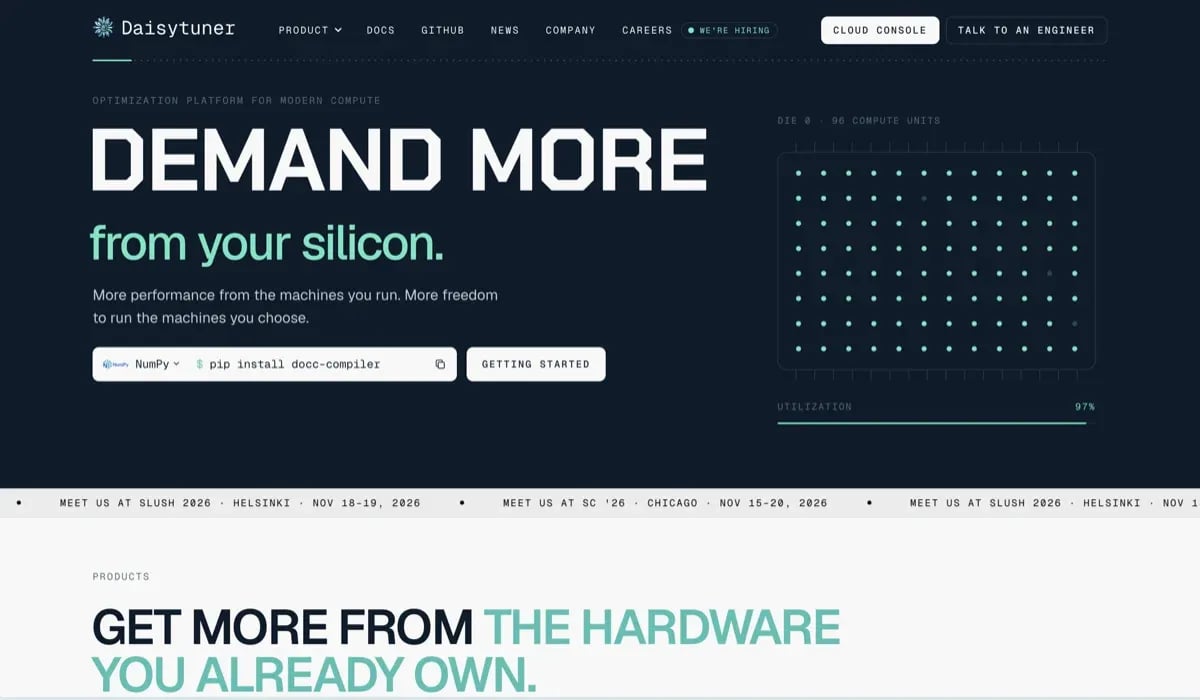


Daisytuner, a Darmstadt startup that builds compiler software for AI workloads, has raised €6m in seed funding. Elaia and LEA Ventures co-led the round, and the Amadeus APEX Technology Fund and Seedcamp also put in money. The deal puts fresh capital behind a small group of European companies betting that the cost of running AI models, not training them, is where the next software opportunity sits.
The company announced the round on 16 November 2026. It is a large step up from its first outside funding: Daisytuner closed a pre-seed round of roughly 1.1 million in May 2025, when it opened a beta version of its product to the public.
What Daisyflow does
Inference is the work a model does each time it answers a request. For businesses that have moved past experiments, it is a recurring bill that grows with every user, and much of it is tied to Nvidia hardware and the software built around it.
Daisytuner's pitch is that the same model can run well on many kinds of processor if the code is tuned for each one. Its platform, Daisyflow, adjusts models while they serve requests. Underneath sits a compiler that uses machine learning to rewrite software so it fits the chip it lands on, whether that is a CPU, a GPU or a dedicated accelerator.
Customers can install Daisyflow in their own data centres. That matters for European banks, manufacturers and public bodies that cannot or will not send data to an outside AI cloud.
The company has published one headline figure. Running Qwen 2.5, the Alibaba model, on AMD Instinct GPUs, its own test found Daisyflow was as much as 18 per cent quicker than vLLM, the open-source inference engine many teams use by default. The result has not been independently verified, and it covers one model on one family of chips.
From ETH Zurich research to a product
The company was founded in 2024 by Lukas Truemper, its chief executive, and Adrian Schmitz. Truemper built the company on his research into AI-driven compilers at ETH Zurich.
The first product looked quite different from today's. The 2025 beta was aimed at developers: it read code from GitHub repositories and pointed out where software was slowing down. Since then the focus has moved to running AI models in production.
The team has kept a public research profile. In February 2026, Ramon Wirsch of Daisytuner gave a talk at FOSDEM in Brussels on DOCC, the Daisytuner Optimizing Compiler Collection, which the company describes as a self-learning compiler for AI accelerators.
Where the €6m goes
Daisytuner said it will spend the money on three things:
- winning more enterprise customers
- further work on its compiler technology
- hiring
Its staff already includes researchers who came from ETH Zurich, TU Munich, RWTH Aachen, TU Darmstadt and the Lawrence Livermore National Laboratory in the US. The company has not disclosed its headcount, its revenue or the names of any customers.
A crowded problem
Plenty of others share the goal. A wave of startups is trying to loosen Nvidia's grip by making it easier to move models onto rival hardware from AMD, Intel and a growing list of accelerator makers. Open-source projects such as vLLM already give engineering teams a free starting point, so any paid product has to show gains large enough to justify the switch.
For a German company, the on-premise angle could help. Interest in keeping AI workloads under European control has risen, and software that gets more out of hardware a company already owns is an easier sale than a new cloud contract.
The next test is commercial. Daisytuner now has to turn a benchmark claim into named enterprise deployments, and show that its compiler delivers similar speed-ups across more models and more chips than the single AMD result it has shared so far.
What did you think of this story?
Written by
John Pulisic
48 stories on European Startup Insider
Have a story like this? Pitch it to us.
We publish founder profiles, company news and practical guides from across Europe.
More stories like this







Helsinki's Intergrid reaches €23.5m in funding as Kvanted and Tesi back its energy Autopilot
Finnish startup Intergrid, whose software runs boilers, heat pumps and power trading for factories and heating plants, has taken total funding to €23.5m and plans to expand across Europe.