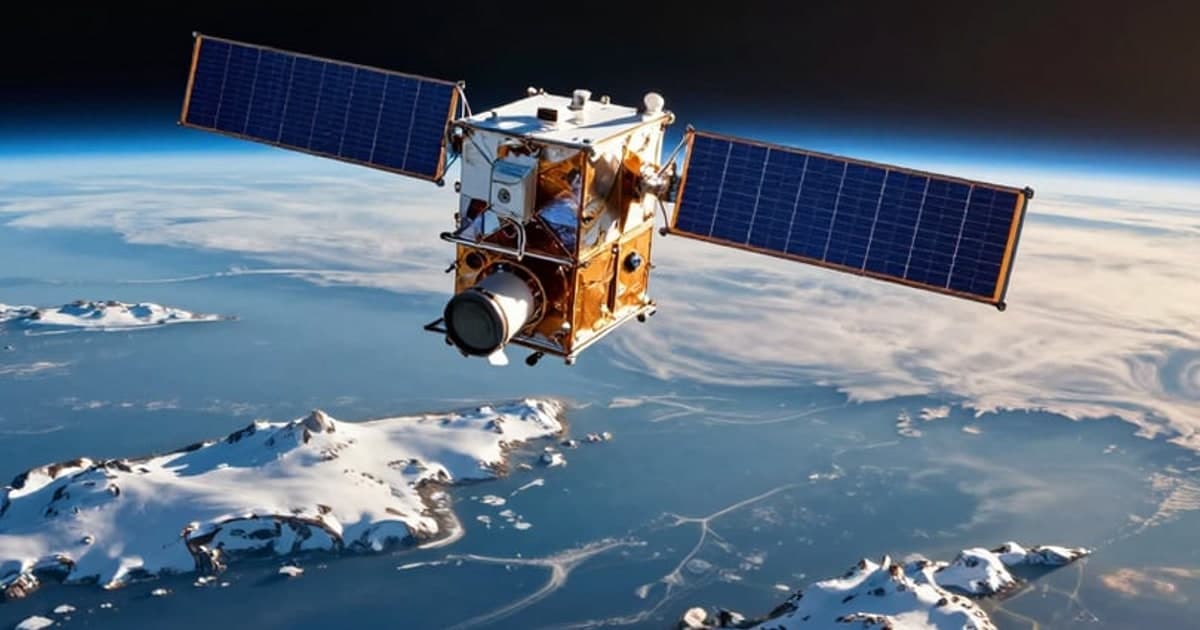

MuRay raises €7.1m, half of it public money, to scan rocket engines and turbines with muon beams

MuRay, a Hamburg deeptech company spun out of the DESY research centre, has secured €7.1m to build an imaging system that uses muon beams to look inside thick metal parts. The package splits almost evenly: €3.5m in private equity and €3.6m in non-dilutive public funding, part of it a grant from the EU's Horizon Europe programme.
The size of the jump stands out. A year ago the company, then trading as mu-ray.tech, came out of stealth with €325,000. The new private money alone is more than ten times that, and the grants roughly double the total, a mix that has become common for European hardware start-ups with long build cycles.
Who wrote the cheques
First Momentum Ventures led the private round. Caelora, a laser company that German fusion developer Marvel Fusion spun out this year and still fully owns, co-led. Superangel, Mätch VC, Arcas VC and Tiny VC joined, as did Nordic Science Investments, which led the 2025 round through partners Mart Maasik and Matti Hautsalo.
Caelora's presence is worth a second look. MuRay's long-term plan depends on a compact laser-driven accelerator to produce its muons, so its co-lead works in the field MuRay most needs to master. Neither company has said whether the tie-up includes any technical work.
The company has two co-CEOs. Kristjan Põder led DESY's research into laser-plasma accelerators for industrial and medical uses. Andi Hektor, an Estonian particle physicist, earlier co-founded GScan, which scans large structures with the muons that fall naturally from the sky. MuRay's difference is that it generates its own controlled beam rather than waiting for cosmic rays. Besides its Hamburg base it runs a software and AI team in Tallinn.
Why rocket makers are the first customers
The pitch rests on a physical limit. Industrial X-ray inspection struggles once steel gets more than a few centimetres thick, while muons, according to MuRay, can travel through over a metre of steel and other dense metals. Detectors and AI software developed in-house turn the particles that pass through a part into a 3D picture of its interior, whether the part is metal, ceramic or composite.
"X-rays reach their limit at a few centimetres of steel, yet much of modern industry, from reusable rockets to gas turbines, is built from metal far thicker than that," said Andi Hektor, co-founder and co-CEO.
MuRay says the method can distinguish materials by composition and density even where they look identical on an X-ray, uses a lower radiation dose, and takes minutes per scan instead of hours. That speed is what would let a manufacturer check every part on the line rather than sampling.
Quality control for 3D-printed rocket engines and gas turbine parts is the opening market. Finding hidden internal defects in these safety-critical parts is still hard with current tools. The company also sees a maintenance case: if reusable rocket engines and jet engines can be inspected more fully, they may spend less time out of service between flights.
Work with the German Space Agency at DLR has so far produced a model of how a rocket engine inspection would run. A test on a real engine is planned for 2027.
A two-step route to market
MuRay does not yet have its own accelerator in service, and the roadmap reflects that. In 2027 it plans to open an imaging service for industrial customers that couples DESY's existing electron beam in Hamburg with MuRay's imaging system. The first full-scale system, built around the compact laser-driven accelerator, is scheduled for 2029.
Part of the new funding goes towards a mobile version roughly the size of a shipping container, meant to be brought to a customer's site rather than shipping heavy parts to a lab. The rest pays for further technology development and commercial work.
"This funding will help us continue proving the physics whilst delivering our first service to industrial customers," said Kristjan Põder, co-founder and co-CEO. The phrasing is candid: the underlying science is still being validated as the company starts selling.
Beyond manufacturing, MuRay is looking at space, aerospace, defence and energy. It is in talks with international ports about using its system to find nuclear material such as uranium inside dense cargo. Further out, it lists radioactive waste monitoring, inspection of bridges and buildings, and clinical diagnostics, the last an area its founders flagged when they first raised money in 2025.
Hiring is the near-term test. MuRay has seven open roles for physicists and engineers at its Hamburg site, among them the first heads of its AI group and of the team building the muon source. It aims to reach about 25 staff by the end of 2027, the same year its first paying service and the DLR engine test are due.
Wie hat Ihnen dieser Artikel gefallen?
Geschrieben von
Mark T. Schwahn
47 Artikel auf European Startup Insider
Haben Sie eine ähnliche Geschichte? Pitchen Sie sie uns.
Wir veröffentlichen Gründerprofile, Unternehmensnews und praktische Ratgeber aus ganz Europa.
Mehr Artikel wie dieser







Google's first space data centre satellite goes online and writes poetry
Google's Project Suncatcher prototype has run its first AI prompt in orbit. Asked for a haiku about space, the Gemma 4 model on board wrote one and sent it down as the satellite passed over Svalbard.