
Marvel Fusion adds €50m to its Series B, bringing the round to €113m as EQT and the EIC Fund join

Marvel Fusion, the Munich company working on laser-driven fusion power, has added €50m to its Series B. The round now totals €113m. Three investors are new to the cap table: EQT Ventures, Siemens Energy Ventures and the European Innovation Council's EIC Fund. The deal shows that some of Europe's larger generalist and corporate investors are now willing to back fusion, a field that used to be left to specialist funds and governments.
The company announced the extension in late March 2025. Two existing shareholders, Tengelmann Ventures and Bayern Kapital, put in more money. For the EIC Fund, the European Commission's equity arm for deep tech, it was the first investment in a fusion company.
A funding mix that leans on public money
Marvel Fusion says it has now raised €385m in total. Private investors account for €170m of that. The other €215m comes through publicly funded research partnerships, so public money makes up more than half of the total.
That split is typical for European fusion. Building and testing machines at this scale costs more than most venture rounds can cover, and early-stage hardware usually relies on public research budgets. Germany's federal innovation agency SPRIND provided the first funding for the company's two laser prototypes. Bringing in EQT Ventures, one of the most active venture firms in Europe, adds a private investor that does not focus only on climate or energy.
Ted Persson, a partner at EQT Ventures, said the firm had followed fusion since its early years. He described the stakes plainly:
"Solving fusion would be a generation-defining moment for humanity."
Where the €113m goes
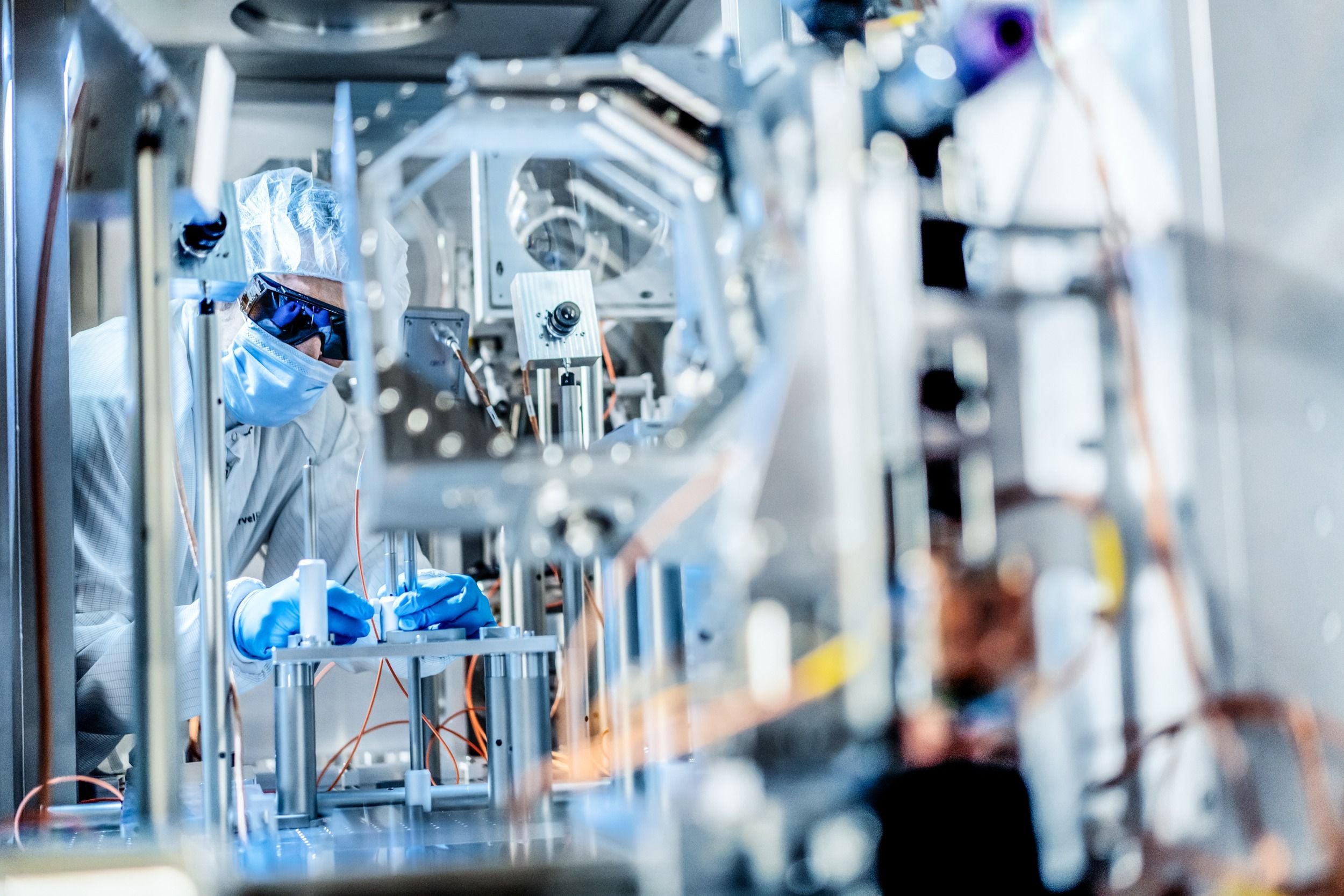
According to the company, the money pays for the shift from research and development to industrial deployment. In practice, most of that work is about lasers. Marvel Fusion fires ultrashort laser pulses at nanostructured fuel targets, so it needs high-energy lasers that can be made in volume and at a cost that would make a power plant pay off.
The largest project is a $150m laser facility being built with Colorado State University in the US. The company is also building two laser prototypes and looking for industrial partners to help it scale up laser manufacturing. It says its lasers must reach high gain, meaning far more energy comes out of the fusion reactions than goes in, for the electricity to sell at a competitive price.
The Siemens Energy link is meant to cover the rest of the plant. The two companies are working together on a conceptual design for a complete fusion power station. Siemens Energy is putting staff and resources into the overall plant layout and into the systems that would move heat and turn it into electricity. Its venture arm now also owns shares in the company.
Moritz von der Linden, Marvel Fusion's co-founder and chief executive, said the new shareholders give the company both money and operational help. He said they would help it hit the milestones needed "on the path to building the world's first fusion prototype."
A Munich company with US hardware
Von der Linden and chief technology officer Georg Korn founded Marvel Fusion in 2019. Von der Linden studied physics at the Technical University of Munich. He was previously a partner at High-Tech Gründerfonds, the German seed investor, and founded the fintech CRX Markets. That mix of physics and venture experience shows in how the company is financed, with private rounds placed alongside large public grants.
The headquarters and much of the team are in Munich, but the biggest machine is going up in Colorado. Von der Linden has since said in public that the company's first demonstrator is being built in the US. He has also argued on stage that Germany needs more venture capital if it wants technological sovereignty. That tension is familiar to European deep-tech founders: the capital and research teams may be in Europe, while the facilities that need the most money end up elsewhere.
For investors, the open question is time. Marvel Fusion has not given a date for a working power plant, and laser fusion still has to prove that it can deliver net energy repeatedly and cheaply. What the company has set out is the next step: finish the Colorado facility and the two prototypes, line up manufacturers for lasers in volume, and turn the joint plant design with Siemens Energy into something closer to an engineering plan.
The EIC Fund's chair, Svetoslava Georgieva, said the stake reflects the view that fusion is a strategic technology for Europe. The next round will test how much European money stays with the company as it moves from prototypes to a plant.
Wat vond je van dit verhaal?
Geschreven door
Sandra J. Barbara
49 verhalen op European Startup Insider
Heb je een verhaal zoals dit? Pitch het bij ons.
We publiceren oprichtersprofielen, bedrijfsnieuws en praktische gidsen uit heel Europa.
Meer verhalen zoals dit




Neko Health closes $700m Series C to take its Stockholm-built body scan to New York
The preventive health company co-founded by Daniel Ek has raised $700m led by Lightspeed and O.G. Venture Partners, nearly triple its 2025 round, to open its first US clinics.