

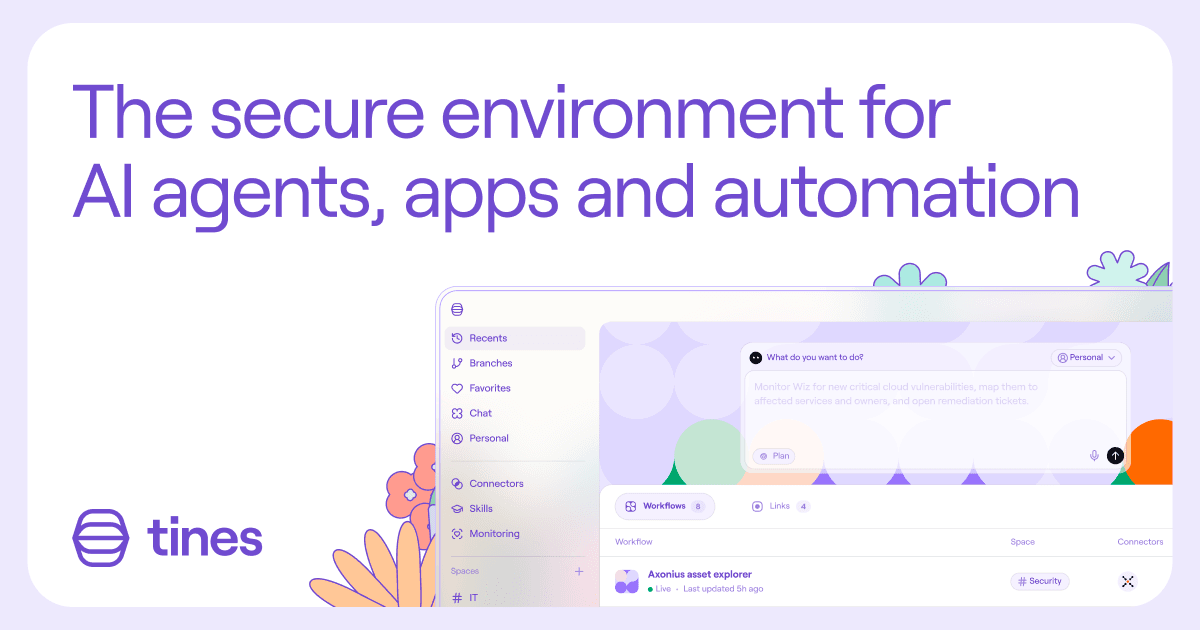

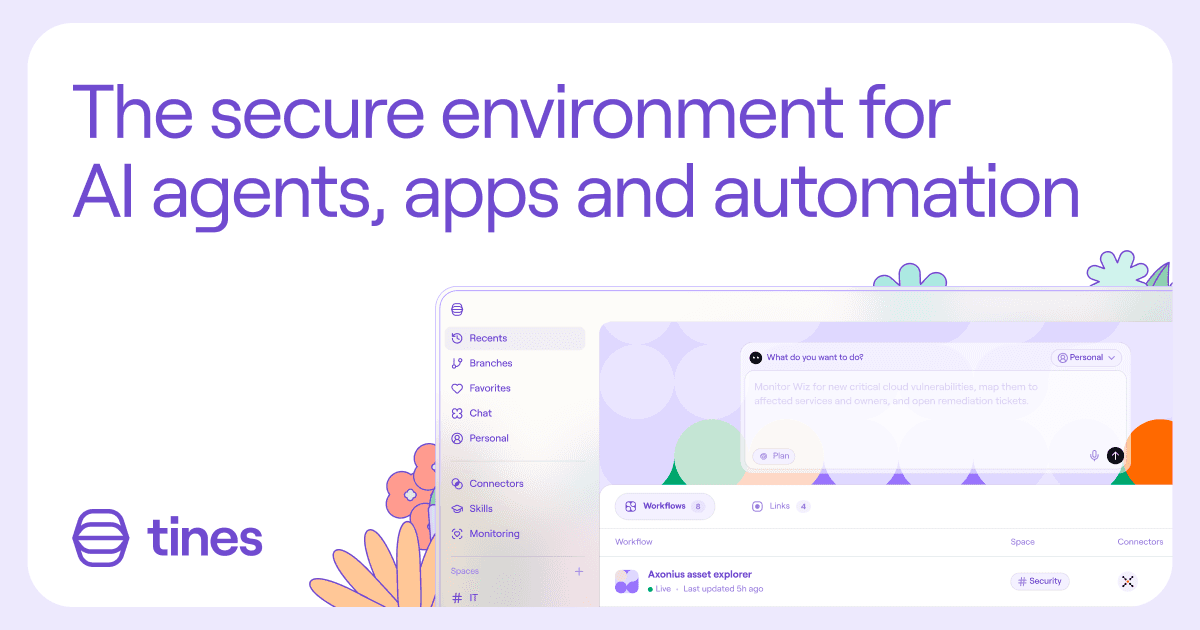
Tines, the Dublin-based security automation company, has launched a second product called Tines 3B, built to let staff across a company create AI-powered apps, agents and automations without losing IT and security oversight. The company announced the launch on 31 July, after what it describes as more than a year of development.
The move matters because it is not a feature update. Tines is running two separate products in parallel: its existing visual, no-code workflow tool, now renamed Tines Stories, stays focused on security and IT operations teams. Tines 3B is a new, code-first environment built specifically for the AI era, aimed at every team in a business, from finance to HR to sales operations.
The problem Tines calls wild code
The launch responds to what Tines calls wild code: employees using AI tools to build software and automations on their own, outside any process their IT or security teams can see. The company points to a case that shaped its thinking. A large financial services customer told staff to use AI more, only to see security incidents double as people shared API keys and uploaded data to unapproved tools without realising the risk.
Eoin Hinchy, Tines' chief executive and co-founder, said the company kept encountering this problem with customers and eventually gave it a name internally. He said building has become almost effortless with AI, but connecting that software safely to a company's systems, and knowing who is responsible for it, has not.
"We built Tines 3B because we believe enterprises need an environment designed specifically to build, run and govern AI-generated workflows, applications and agents," Hinchy said.
Once the team grasped the scale of the problem, Hinchy said, it became clear that adding AI features to the existing Tines product would not be enough. That judgment is why the company chose to build a separate platform instead of extending the old one.
The company cites a study from IBM. It found that 77% of organisations say AI adoption is now moving faster than their ability to govern it, a gap Tines says 3B is designed to close.
How 3B is meant to work
With Tines 3B, a user describes what they want to build in plain language, and the platform generates it, but only with access to the systems and data the organisation has already approved. Once built, an app, agent or automation can go live across the business straight away, with credential protection and full activity logging attached.
Each step of a workflow runs inside an isolated environment that is discarded once it finishes, which the company argues rules out cross-contamination between different runs or users. A self-healing feature is meant to catch edge cases so a workflow keeps running rather than breaking when it meets something its builder had not planned for. For IT and security teams, 3B also works as a dashboard showing everything running across the organisation, not just a tool for building workflows.
One early customer is Fin, the customer-service AI company formerly known as Intercom. Emanuele Sparvoli, its senior director of IT, said governance was the deciding factor in adopting the new platform.
"3B's governance and monitoring capabilities, including strong credential protection and access controls, were central to our decision to deploy it," Sparvoli said. He added that the rollout, a few weeks in, was already becoming central to how teams build at Fin.
Why start from scratch rather than upgrade
The renamed original product, Tines Stories, was built as a no-code tool, which made sense in 2018, when getting non-engineers to automate anything meant hiding the code behind a visual builder. That assumption no longer holds, the company argues, now that AI models can translate a plain-language request directly into working code, which makes a code-first design the more natural fit for the new product. Existing Tines Stories customers keep full access to that product and get free access to try 3B as well. The company says it will keep investing in and hiring for the older platform rather than retiring it.
During a roughly three-week internal rollout of 3B, Tines says, its own staff shipped more than 500 apps, agents and automations. Most were built by people who had never written code, covering tasks such as procurement workflows, sales forecast dashboards and account research tools. Some design partners who tested the product before launch have already become paying customers, though the company has not named them beyond Fin.
A bigger bet for a scaleup
The launch follows a strong year for the eight-year-old company: Tines says it tripled its enterprise customer base in 2025, grew headcount by more than half, and more than doubled the volume of automated actions it runs for customers. It closed a $125m Series C round in February 2025, led by Goldman Sachs Alternatives, SoftBank Vision Fund 2 and Activant, valuing the company at $1.125bn, and has raised $272m in total.
Running two products side by side is a riskier path than simply bolting AI onto an existing one, and it will take more engineering and support resources to maintain both. The company's next test is whether security-conscious customers that trusted Tines Stories for years are willing to migrate sensitive workflows to an entirely new, code-first platform, or whether most end up running both at once, as Tines expects some will.
What did you think of this story?
Written by
John Pulisic
92 stories on European Startup Insider
Have a story like this? Pitch it to us.
We publish founder profiles, company news and practical guides from across Europe.
More stories like this






Picnic raises €430m to pour into German grocery delivery build-out
The Amsterdam-based online supermarket has secured €430m from existing backers including EDEKA and the Gates Foundation, mostly to expand its logistics network in Germany, where it says it is now the market leader.