

Cherry Ventures leads €6m seed extension for Bremen's Marble Imaging as it orders more satellites

Marble Imaging, the Bremen company building a fleet of very-high-resolution (VHR) imaging satellites, has raised a further €6m in a round led by Cherry Ventures. The money extends a €5.3m seed led by High-Tech Gründerfonds (HTGF) less than a year ago, so the startup has now raised €11.3m in seed equity before a single satellite of its own has reached orbit.
The pitch is about dependence. Most of the sharp optical imagery that European governments and companies use for security work is bought from providers outside Europe, and Marble argues that buyers can lose coverage of the places they care about when a supplier or its government decides so. The company points to Ukraine and the Strait of Hormuz as cases where that risk became real.
What the €6m pays for
According to the company and its investors, the new capital is meant to speed up the build-out of the constellation, chiefly by buying additional satellites and securing launch capacity. Marble's stated target is 30 satellites in orbit by 2030.
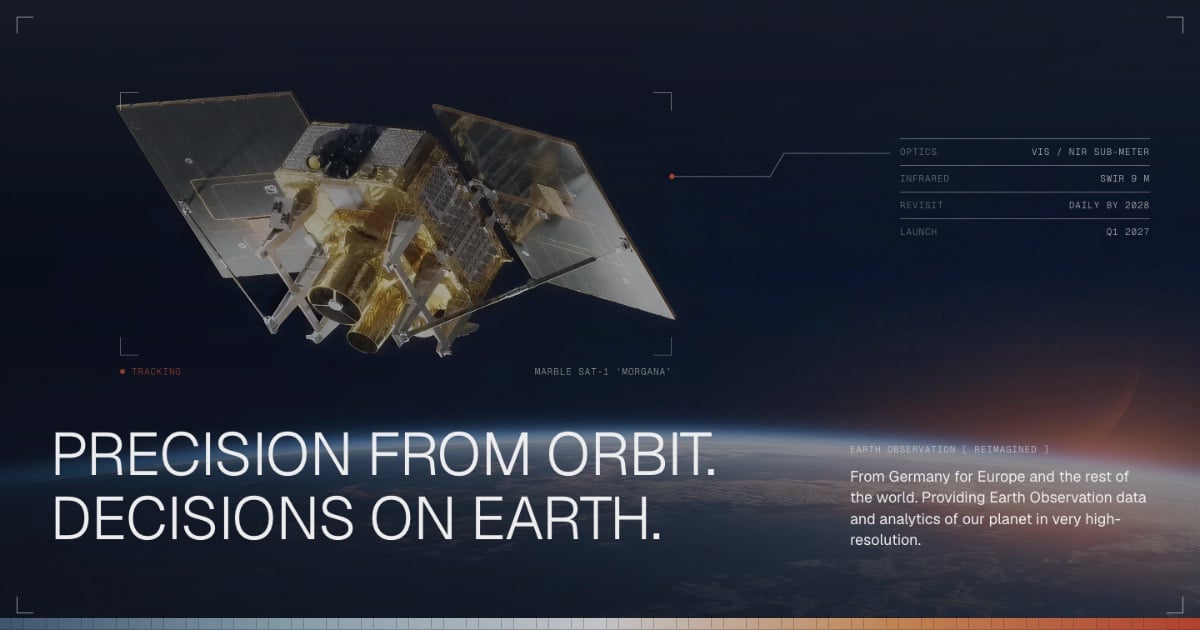
Its first spacecraft, Marble Sat-1, is already paid for. The company says it has finished pre-flight testing and is due to fly in early 2027. The spacecraft should take pictures at up to 0.7 metres resolution in visible and near-infrared light and will also collect short-wave infrared data, which can reveal differences in surfaces and materials that ordinary colour images miss. Speaking at the International Space Summit in Paris in September, chief executive Robert Hook presented the satellite, which was built by Reflex Aerospace.
Hook framed the round as a matter of buying hardware rather than solving engineering problems.
“Scaling from here is a question of capital, not technology,” said Robert Hook, co-founder and CEO of Marble Imaging.
He said demand had been proven, that the hardware comes from established suppliers and that Marble's software already has paying customers. The company did not name those customers or disclose revenue.
Software first, satellites second
Marble has not waited for its own imagery to start selling. It already offers analytics built on third-party data, including object detection for situational awareness, terrain and trafficability assessment, monitoring of coastal assets and land cover classification. Alongside the satellites it is building an AI platform that combines imagery from several sources and turns it into decision support for defence, civil security and critical infrastructure clients.
The idea is that the two halves reinforce each other. As more Marble satellites come online, the company expects its own data to feed and train the analytics models, which it sees as an advantage over firms that only resell pictures or only write software.
Filip Dames, founding partner at Cherry Ventures, said the firm was backing a product that Europe currently lacks.
“Europe needs its own eyes in space, and Marble Imaging is building them,” Dames said.
For Cherry, which usually invests at pre-seed and seed and counts The Exploration Company and Proxima Fusion among its portfolio companies, the deal adds another bet on European hard tech with a defence and sovereignty angle.
A crowded seed table and a later timeline
The company was founded in August 2023 by Hook, Dr Gopika Suresh, who serves as chief strategy officer, and Alexander Epp, its commercial chief, with Dr Raul Scarlat as lead instrument scientist. Before raising any equity it secured more than €10m in non-dilutive funding through the DLR Small Satellite Payload Competition and ESA's InCubed programme, plus a €3m anchor contract under ESA's Copernicus Contributing Missions scheme.
The December 2025 seed, which was oversubscribed, brought in a long list of backers alongside HTGF. They included Bremen's public investment arm BBM, the Sparkasse Bremen investment companies nwk and nwu, family office Lightfield Equity, Oslo Venture Company, defence-focused Sentris Capital, the Auxxo Female Catalyst Fund and SpaceFounders, the venture arm of the French space agency CNES.
The plan has shifted since then. At the time of the HTGF round, Marble expected to launch its first satellite in the fourth quarter of 2026 and to grow its fleet to as many as 20 spacecraft before 2029. The first launch is now set for early 2027, and the fleet target has grown to 30 but moved out to 2030. The delay is a matter of months, but it matters for a company whose business model depends on owning its own data.
The company also said a year ago that it was preparing a Series A to fund the wider constellation. This extension buys time and hardware before that larger round. Whether Marble can raise it on good terms will depend largely on how Sat-1 performs once it is in orbit, and on whether European defence and security buyers turn their stated interest in sovereign imagery into multi-year contracts.
What did you think of this story?
Written by
Sandra J. Barbara
58 stories on European Startup Insider
Have a story like this? Pitch it to us.
We publish founder profiles, company news and practical guides from across Europe.
More stories like this






Darmstadt's Daisytuner raises €6m seed to run AI models faster on chips beyond Nvidia
Elaia and LEA Ventures co-led a €6m seed round in Daisytuner, whose Daisyflow platform tunes AI models at inference time for whichever processors a company runs.