

ValkaAI adds €1m from ff Venture Capital and Look AI Ventures, taking its Prague pre-seed to €13m

ValkaAI, the Prague startup building AI characters that react to live sport and esports, has added €1m to its pre-seed round, bringing the total to €13m. The new money comes from ff Venture Capital and Look AI Ventures, which join the investors that backed the company in February.
The extension is small next to the original cheque. What it adds is two more names on the cap table at a stage when the company still has to prove it can sell a product that is expensive to build. In local currency the round is now worth roughly CZK 317m.
A record round gets bigger
The first tranche, €12m announced on 24 February, was led by Rockaway Ventures. J&T Ventures, Tensor Ventures, BD Partners, the Fond Naše Česko fund and angel investor Petr Zámečník also took part. Czech press described it as the largest pre-seed ever raised by a startup with Czech founders, and it was the company's first outside capital.
That size of round at the earliest stage owes a lot to the founders' record. Vlastimil Venclík, ValkaAI's chief executive, also runs Oddin.gg, which sells esports match data and analytics to bookmakers. Oddin.gg was ranked the fastest-growing tech company in Central Europe in Deloitte's Fast 50 for 2024, with growth of 7,958%, and won the list again the year after. ValkaAI split off from Oddin.gg as a separate company in 2025 and sits within Realms Group. Venclík co-founded it with Miloš Lokajíček, the chief operating officer, who previously worked at AI startups including Filuta.
The two new funds see live commentary as an entry point. Angelo Burgarello, a partner at Look AI Ventures, framed the bet around how sport is broadcast today.
“For eighty years, sports broadcasting has been a monologue: one commentator, one script, millions of viewers.”
Burgarello added that producing a flashy AI clip is now easy, while turning AI video into a whole business is not, and that the second part is what his fund is paying for. Mariusz Adamski, a partner at ff Venture Capital, said commentary is only the first use of a broader plan, and that delivering it will take deep technical skill and the ability to turn research into products people actually want.
What the commentator does
ValkaAI is building its own models rather than wrapping someone else's. The work covers three areas: generating video, generating voice, and understanding what is happening on the pitch or in the game. According to the company, the hard part is getting all three to run together in real time, so that a character answers with speech, facial expression and movement without a visible lag.
When it announced the February round, the startup said its system works from a compact representation it calls a "language of motion", along with a proprietary control model. Every frame is produced separately, driven by whatever arrives live: a viewer's voice, a hand movement or something that just happened in the match. The aim is to avoid the flicker and warping that often show up in generated video.
The first product built on this is ValkaAI Commentator. It takes match data from a live sports or esports broadcast and produces commentary as the action happens. A single match can carry separate tracks for different languages, personalities or audiences, which is the pitch to broadcasters and rights holders who serve fans across many markets. A short demo released in October showed it calling a Counter-Strike 2 duel. Czech esports caster David Vogel recorded the voice data behind one of its voice models last year.
Since February the headcount has grown to around 50 people, spread across Prague, San Francisco and Dubai. The company says some of its researchers previously worked at Meta and DeepMind.
Where the money goes, and what it costs
ValkaAI said the new funds will go into faster research on real-time video and audio generation, hiring senior AI researchers, and its first deployments with commercial partners. No partners were named.
Compute is the big line item. Last December the founders estimated that training their models would take about one million GPU hours, which they put at €5m to €6m in compute alone. On those figures, close to half of the €13m round could end up paying for GPUs before the payroll of a 50-person team is counted.
Timing is the other pressure. At that point the founders expected the first commercial rollout in the second half of 2026, a window that closes in about six weeks. The latest announcement still describes first deployments as a goal for the new money rather than something already live.
Venclík has said live entertainment depends on reactions, personality and emotion, and that offering that to every audience is hard to scale with today's tools. He describes the problems his team is working on as research questions existing models were not designed to answer. The founders have already pointed to uses beyond sport, including virtual assistants at airports and in shops, and said they are in talks with athletes about licensing their likeness. The next test is whether a broadcaster or league signs up to put the commentator in front of paying viewers.
What did you think of this story?
Written by
Sandra J. Barbara
58 stories on European Startup Insider
Have a story like this? Pitch it to us.
We publish founder profiles, company news and practical guides from across Europe.
More stories like this

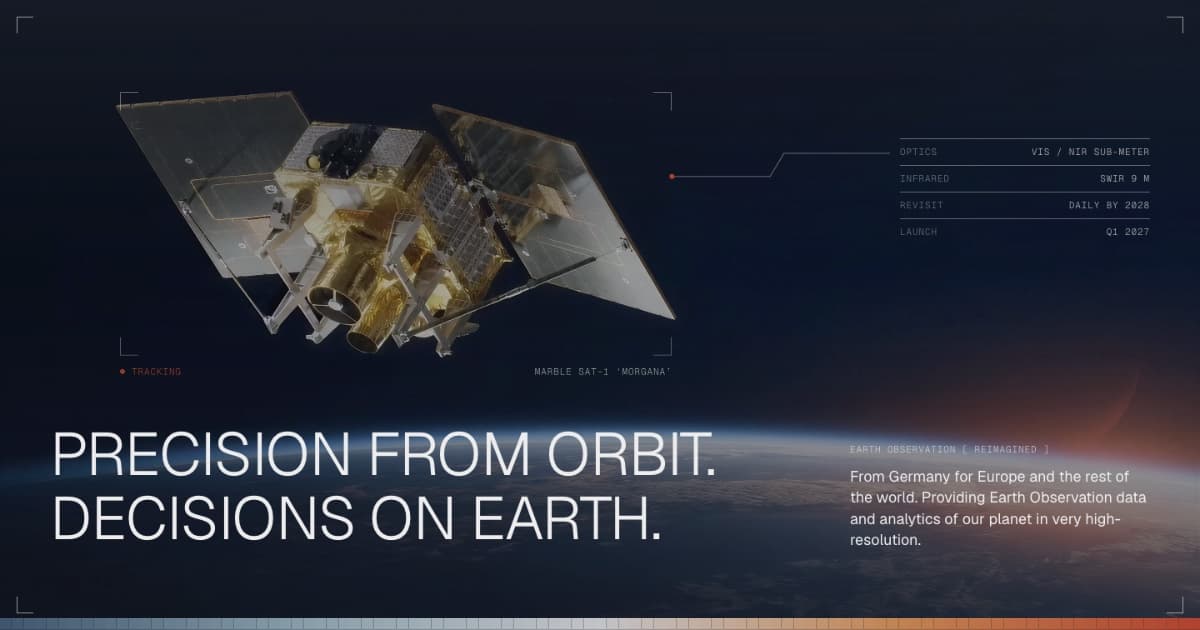




Cherry Ventures leads €6m seed extension for Bremen's Marble Imaging as it orders more satellites
The Bremen Earth observation startup has added €6m to its seed, taking it to €11.3m. The cash goes on satellites and launch slots ahead of its first spacecraft's early-2027 flight.