

How an ETH student robotics club produced Theseus, now testing night-shift robots in Zürich and California
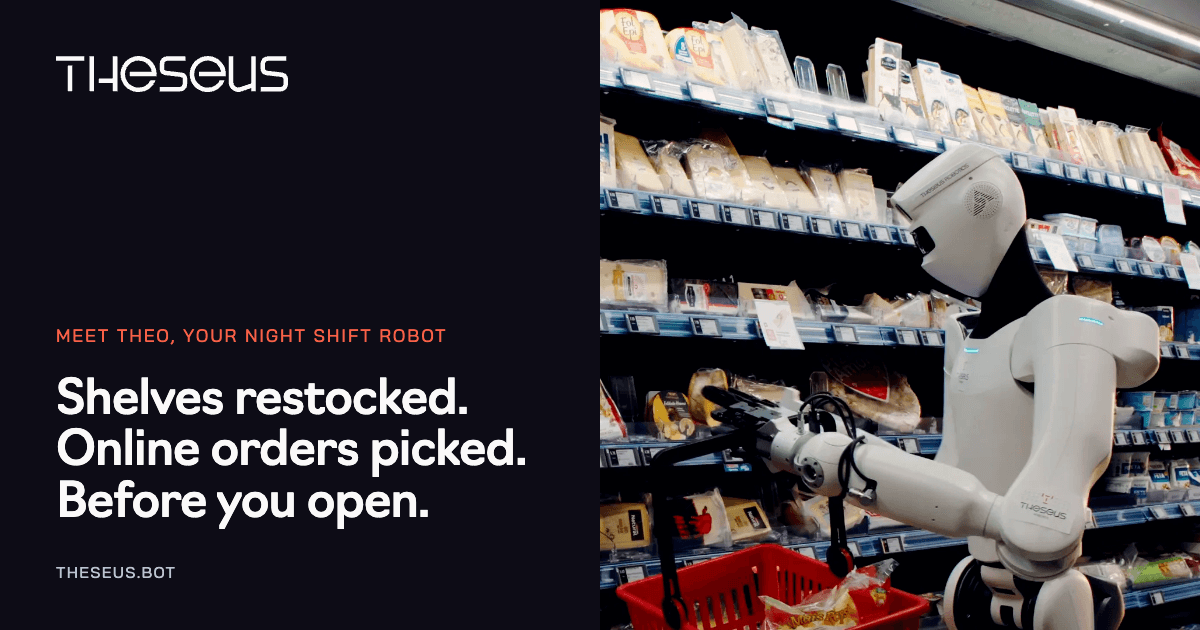

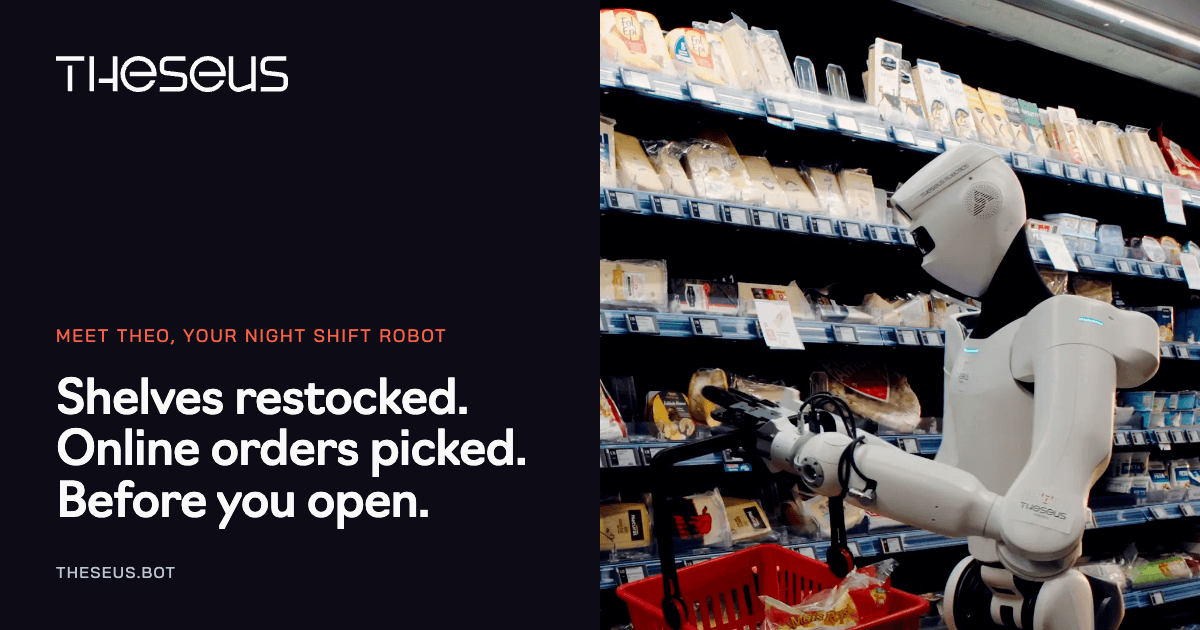
Theseus Robotics was founded in 2026, and before the year is out it has robots restocking shelves in two stores, a $500,000 cheque from Y Combinator and a first US grocery deployment in Silicon Valley. The Zürich company got there with eight people and without building a robot of its own.
Theseus buys wheeled, two-armed humanoids from hardware makers and puts its effort into the software that makes them work in a supermarket aisle.
Out of a student club
The company's roots are in the ETH Robotics Club, the student robotics group at ETH Zürich, and Theseus is the first startup to spin out of it. Kristóf Floch, now CTO, had been the club's VP Technology, in charge of more than 100 student engineers, while doing research on physical AI that has produced eight published papers. His work at ETH and at SZTAKI in Hungary looked at combining learning-based and classical control.
Two more technical co-founders round out the team. Ádám Weinhardt-Kovács, who studied robotics there, had been one of the first hires at Flink Robotics, designing grippers and putting pick-and-place robots into parcel warehouses, where his machines kept up with human pickers at 800 picks an hour. Jianwen Cao, the chief research officer, took charge of the learning models and has published at the CVPR and ICRA conferences.
The commercial side came from Samarth Malhotra, the chief executive. He had already bootstrapped a manufacturing and e-commerce business that operated across the US, Germany, China and India, and he once scaled an online business to $3m in revenue. He studied computer science at Carnegie Mellon and worked as a data scientist at Facebook.
Picking a narrow job
The team settled on one task: the last few metres between the stockroom and the shelf. Warehouses are heavily automated, but refilling individual products and picking online grocery orders is still done almost entirely by hand, often at night. Theseus puts the bill for manual restocking at more than $60bn a year across the US and Europe.
“Robot hardware is turning into a commodity, so we build the brain,” said Malhotra, the chief executive.
The founders first paid for a proof of concept themselves. The company also runs a demo supermarket near Zürich, where engineers move stock around and knock the shelving to see how the robot copes, and it tests Theo in simulation across thousands of products with help from large US robotics AI labs.
Investors, pilots and live stores
Outside money arrived after the bootstrapped phase. Founderful Campus, S2S Ventures, Earthling VC and Berlin-based Caesar Ventures backed the company, though none of the sums have been made public. With that funding, Theo went into trials on both sides of the Atlantic with grocers and pharmacy chains, plus two big American delivery platforms.
By its launch with Y Combinator's Fall 2026 batch, Theseus had two robots working in two stores. Its own figures put Theo at up to 400 units an hour when restocking and up to 40 when picking orders, though remote operators still take over when it gets stuck. Cao's models, according to the company, have reached 99% success rates in its testing.
The company presented itself publicly on 7 November with footage from its Zürich deployment. Y Combinator's $500,000 is what is paying for the move into a Silicon Valley grocery store, its first in the US.
Next comes scale. Theseus plans wider pilot programmes in Switzerland, Germany and the US in the first quarter of 2027 and says it has pilots lined up for up to 10 more robots that year. It is asking for introductions to store operations and logistics teams at grocers, drugstores and fashion retailers in those three countries.
The offer to a retailer is simple: no robots to buy, one monthly fee, and a start in a single store. Whether Theo can hold its rates with less remote help, across many shops rather than two, is what the 2027 pilots will show.
What did you think of this story?
Written by
Sandra J. Barbara
63 stories on European Startup Insider
Have a story like this? Pitch it to us.
We publish founder profiles, company news and practical guides from across Europe.
More stories like this

Zürich's Theseus Robotics rents out wheeled humanoids that refill supermarket shelves while stores are shut
Theseus Robotics writes the software that turns bought-in two-armed robots into night-shift shelf stockers and order pickers for grocers, charged as a single monthly fee.