

Zürich's Theseus Robotics rents out wheeled humanoids that refill supermarket shelves while stores are shut
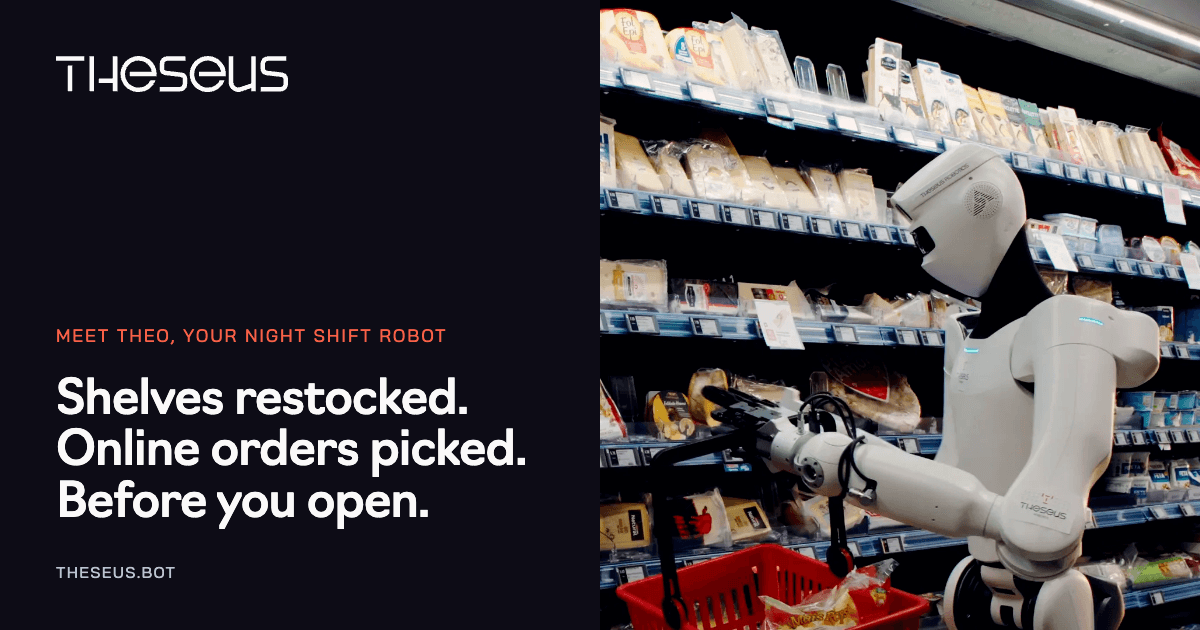

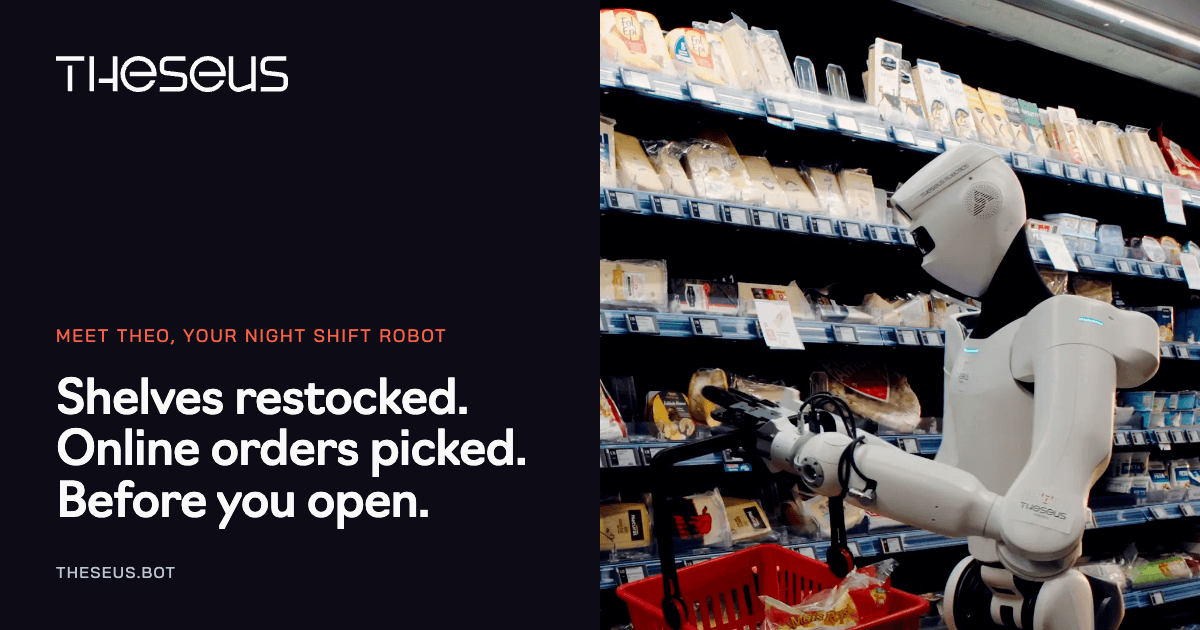
Theseus Robotics sells supermarkets a night shift. Its robot, Theo, rolls out of the stockroom after closing time, fills the gaps on the shelves and checks what is there, and earlier in the evening it picks items for online grocery orders. The Zürich company, which also works out of San Francisco, charges retailers one monthly fee and does not sell the robots.
The problem it goes after is old and expensive. By Theseus's count, Europe and the US together have upwards of 100,000 big supermarkets, which spend above $60bn a year paying people to restock by hand: opening cartons, wheeling them out and filling every facing. Much of that happens at night, and the company says stores struggle to keep those jobs filled.
What Theo actually does
Theo is a two-armed humanoid on a wheeled base, and the company gives it four jobs. It carries goods from the back room to fill empty spots, and it gathers items for online orders so they are ready before the doors open. As it moves it scans for gaps, products in the wrong place and incorrect price labels. It also checks dates, pulling older stock to the front and taking expired goods away.
Each arm lifts up to 5 kg and reaches 0.8 metres, enough to work from the bottom shelf to the top and from the front of a shelf to the back. A turning, bending waist gets it into tight corners. Cameras in the head give stereo and depth vision, while depth cameras in the chest and wrists read barcodes. Two 360-degree lidars, one at each end of the base, let it drive the aisles without rails or floor markers.
The deployment pitch is about avoiding work for the retailer. Theo carries its own network, so a store does not need its IT team involved, and it charges from an ordinary wall socket on either European or US power. Theseus says its AI learns to recognise new products after a few nights in a store. When the robot gets stuck, a Theseus operator takes control remotely.
Software on someone else's hardware
The company does not build robots. It buys proven wheeled humanoids from manufacturers and writes the operating system and AI models that make them useful on a shop floor. That covers perception to find where to grip each item, learned skills for placing thousands of different products from yoghurt pots to cases of water, and links into store systems that read delivery lists and planograms.
“Robot hardware is turning into a commodity, so we build the brain,” said Samarth Malhotra, co-founder and CEO.
Testing starts in simulation, where Theo practises on thousands of products before going near a real store. Theseus also runs a demo supermarket near Zürich where engineers shift goods and bump the shelving to see how the robot recovers, and force sensors stop it crushing delicate packs.
What Theo sees is turned into data for the retailer. Each pass updates a digital copy of the shelves, a record of what is physically on each one, product by product. From that the system can suggest changes to the shelf plan and list out-of-stocks, which it then fills from the stockroom overnight. The company says it can restock up to 400 units an hour and pick up to 40.
The team and where it stands
Theseus was founded in 2026 and is the first spinoff from the ETH Robotics Club at ETH Zürich. It has a team of eight, led by four founders.
Chief executive Samarth Malhotra is a second-time founder who has scaled an e-commerce business to $3m in revenue. He studied computer science at Carnegie Mellon and worked with data at Facebook. Kristóf Floch, the CTO, builds the robots' AI, drawing on research at ETH Zürich and SZTAKI that blended learned and classical control methods.
Product chief Ádám Weinhardt-Kovács was an early engineer at Flink Robotics, where he built grippers and installed pick-and-place robots in parcel warehouses. Jianwen Cao, chief research officer, runs the robot-learning models and has published at CVPR and ICRA.
The company is part of Y Combinator's Fall 2026 batch, and the accelerator put in $500,000. Earlier backers include Founderful Campus, S2S Ventures, Earthling VC and Caesar Ventures, with amounts not disclosed. Two robots are working in two stores, the launch footage was shot in its Zürich deployment, and its first US grocery store is in Silicon Valley.
Retailers can start with a single store and add more one at a time. Theseus is now handing out 2027 pilot slots to grocers, drugstores and fashion chains in the US, Switzerland and Germany, with up to 10 more robots lined up for next year.
What did you think of this story?
Written by
Mark T. Schwahn
58 stories on European Startup Insider
Have a story like this? Pitch it to us.
We publish founder profiles, company news and practical guides from across Europe.
More stories like this

Zürich's Theseus Robotics takes its shelf-filling robot Theo to a Silicon Valley grocery store
Fresh from Y Combinator with $500k, the eight-person ETH spinoff is placing its first US grocery robot in Silicon Valley and lining up wider pilots in Switzerland, Germany and the US for early 2027.