

Zürich's Theseus Robotics takes its shelf-filling robot Theo to a Silicon Valley grocery store
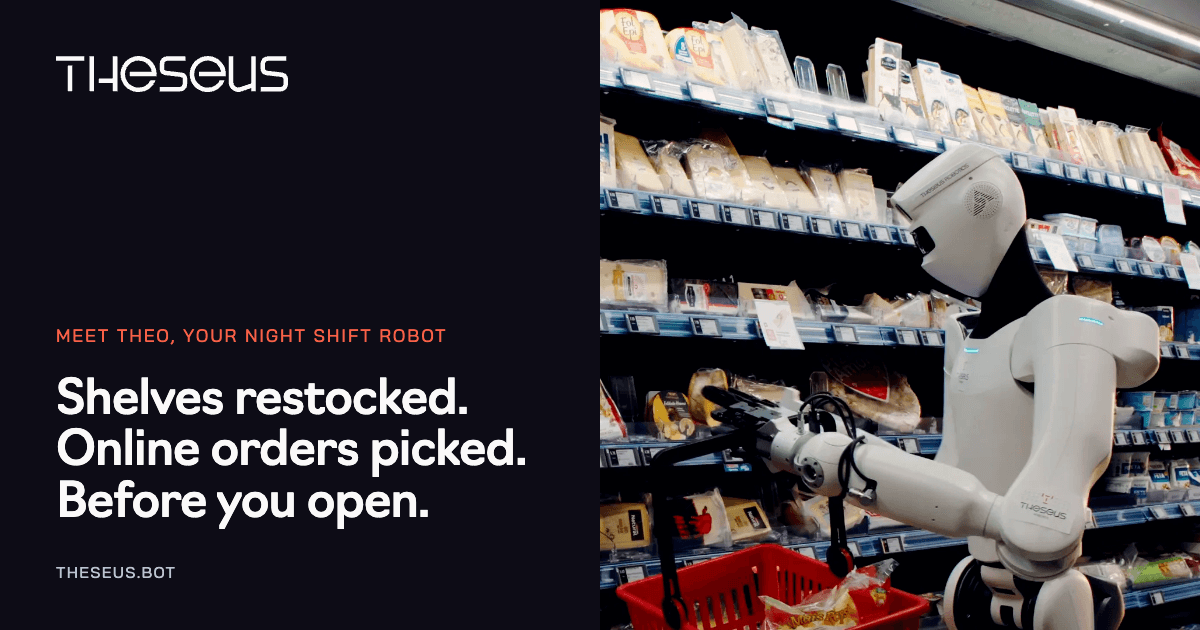

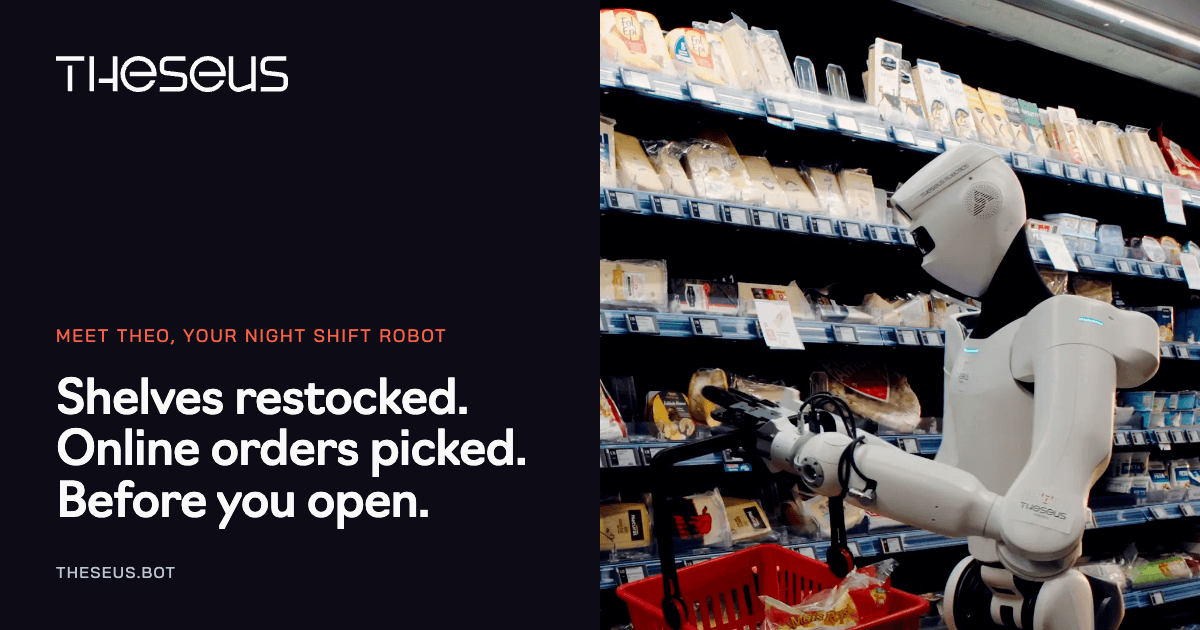
Theseus Robotics, a Zürich startup that writes the software for wheeled two-armed robots, is putting its robot Theo into its first US grocery store, in Silicon Valley, after taking $500,000 from Y Combinator. The eight-person company plans larger pilot programmes in Switzerland, Germany and the US in the first quarter of 2027.
The move matters because store shelves are one of the last stretches of the grocery supply chain still worked almost entirely by hand. Warehouses that feed supermarkets have been automated for years. The final few metres, from the back room to the shelf and from the shelf into an online order basket, have not.
A night shift and a day shift
Theo is built to split its day in two. Until 9pm it picks items for online grocery orders. Once the store closes, it switches to restocking from the stockroom and keeps going until doors reopen at 9am. The company puts its peak rates at up to 400 units an hour for restocking and up to 40 units an hour for picking.
Those are Theseus's own numbers, and the launch material gives too little detail to compare a full robot shift with a human crew. The robot is also not fully on its own yet. When Theo gets stuck, a person working remotely for Theseus takes over, and the company says this help also produces data it uses to make the robot more autonomous. How often that happens in a live store will shape the real cost of a night's work.
The company states the size of the prize plainly. By its count there are more than 100,000 large grocery stores across the US and Europe, and they spend upwards of $60bn a year on manual restocking. The work is heavy and repetitive, mostly done overnight, and stores find it hard to keep staff in those jobs.
Building the brain, not the body
Theseus does not make robots. It buys proven wheeled humanoids and supplies the operating system and AI models that let them handle thousands of different products on shelves that never look the same twice.
“Robot hardware is turning into a commodity, so we build the brain,” said Samarth Malhotra, co-founder and CEO of Theseus Robotics.
Before Theo touches a real shelf, the startup runs it through simulation across thousands of products, helped by a collaboration with US robotics AI labs that it says are valued at more than $10bn. It did not name them. Near Zürich it keeps a demo supermarket where the team moves products around and knocks into shelving on purpose to see how the robot copes. Force sensors let it pick up yoghurt cups and cardboard packs without squashing them.
The robot also compares what it sees with the retailer's planogram, the plan that says which product sits where. That gives store managers a live picture of gaps and misplaced stock, which the company pitches as a way to raise availability and tune the supply chain behind the shop.
From bootstrapping to Y Combinator
Theseus is the first company spun out of the ETH Robotics Club, a student group at ETH Zürich. The founders paid for the first proof of concept themselves. Swiss and European backers followed, with undisclosed cheques. They include Founderful Campus, S2S Ventures, Berlin's Caesar Ventures and Earthling VC, an early-stage investor that writes first cheques into robotics and AI teams on both sides of the Atlantic.
That early money paid for pilots with supermarket and pharmacy chains in Europe and the US, and with a pair of major American online delivery platforms, which the company did not name. According to its Y Combinator profile, two robots are already working in two stores, and footage from its Zürich deployment was released when the company launched with the Fall 2026 batch on 7 November.
The $500,000 from Y Combinator is the only figure the company has made public. Retailers do not buy Theo; they pay Theseus a monthly fee.
The founding group combines commercial experience with academic robotics. Chief executive Malhotra is on his second company, after a self-funded manufacturing and online retail business that operated in Germany, China, India and the US; he also worked with data at Facebook and holds a computer science degree from Carnegie Mellon. CTO Kristóf Floch, an ETH Zürich robotics engineer with eight papers on physical AI, was once the student club's technology chief, in charge of over 100 engineers. Product chief Ádám Weinhardt-Kovács joined Flink Robotics early and installed its robots in parcel warehouses, and Jianwen Cao, head of research, trains the models that control Theo.
The company is now hunting for 2027 pilot partners in the US, Switzerland and Germany. It wants introductions to store operations and logistics teams at grocers, drugstores and fashion retailers. It has pilots lined up for up to 10 more robots next year, and the Silicon Valley store, its first US grocery deployment, will show whether Theo can hold its rates on an American night shift.
What did you think of this story?
Written by
Jascinta Clark
57 stories on European Startup Insider
Have a story like this? Pitch it to us.
We publish founder profiles, company news and practical guides from across Europe.
More stories like this

From 60 Amsterdam garages to an airport deal: how ParkBee built a parking network in four countries
Founded in 2013, ParkBee went from retrofitting barriers in Amsterdam to raising €30m, linking its car parks to apps like JustPark and, this month, buying MOBIAN's airport parking business.